
Have you ever considered how Daenerys Targaryen and Aemond Targaryen’s story arcs are rather similar in Game of Thrones and House of Dragons? The Targaryens of George R.R. Martin’s world have always been complex figures defined by power, pride and the burden of their family legacy. Aemond and Daenerys endure humiliation, loss and dragon-fueled growth, becoming fearsome dragonriders whose actions alter the course of history. Their stories mirror each other in several striking ways, revealing how the Targaryen bloodline shapes its descendants toward greatness and destruction alike. Daenerys Targaryen from Game of Thrones and Aemond Targaryen from House of the Dragon stand out as two of the most fascinating and tragic characters in modern high fantasy, so let’s explore what these two dragonriders have in common.
“Every time a Targaryen is born, the gods toss a coin and the world holds its breath.”
— Ser Barristan Selmy, A Storm of Swords (also referenced by Tyrion in Game of Thrones)

Both Daenerys and Aemond Targaryen experience deep humiliation at the hands of their family members, particularly from those meant to be their companions. Daenerys’s early life in Game of Thrones is dominated by her brother Viserys, who treats her as property rather than a sister. Viserys constantly reminds her that she exists only to restore his claim to the Iron Throne. He sells her into marriage with Khal Drogo, ignoring her feelings and safety. Daenerys is verbally and emotionally abused, made to feel powerless and insignificant. Her humiliation is rooted in dependence and fear, and for much of her early life she believes she has no identity beyond what her brother assigns her. The phrase “You don’t want to wake the dragon” captures the threat that defines her existence. Daenerys’s suffering under Viserys is worsened by her isolation, as she has no allies or family to defend her.

Aemond Targaryen from House of the Dragon suffers a similar form of familial cruelty, though in his case it comes from both his brother Aegon and his cousins Jacaerys and Lucerys Velaryon. Aemond is mocked relentlessly for being the only child of Alicent and Viserys without a dragon. The bullying reaches its peak when his cousins present him with a pig and call it “Pink Dread,” a cruel parody of the dragons that symbolize Targaryen pride. His brother Aegon joins the taunting, calling him “Aemond One-Eye” after his later injury. Throughout the House of Dragons show Aegon dismisses Aemond as inferior and humorless, mocking him for not having a dragon and for finding affection in brothels without acknowledging his own shortcomings or the skilled fighter Aemond has become. While Daenerys’s humiliation is ongoing and rooted in helplessness, Aemond’s is public and rooted in ridicule. Both, however, emerge from these experiences with deep resentment and an unyielding drive to prove themselves worthy of their name.
“A Targaryen alone in the world is a terrible thing.”
— Jorah Mormont, Game of Thrones

The price of power for both Daenerys and Aemond comes through personal loss. In Game of Thrones, Daenerys’s dragons are born out of grief and sacrifice. When Khal Drogo lies comatose and her unborn child dies as the result of Mirri Maz Duur’s blood magic, Daenerys walks into Drogo’s funeral pyre with the dragon eggs she received as wedding gifts. She loses her husband, her son and everything that once tied her to her old life. What emerges from that fire are her three dragons, Drogon, Rhaegal and Viserion, and with them, her transformation into the Mother of Dragons. Her dragons are born not out of conquest but out of death and sorrow, symbolizing both her strength and the heavy cost of Targaryen power.

Aemond’s claim to Vhagar, the largest and oldest living dragon during House of the Dragon, also comes at a terrible price. After claiming Vhagar on Driftmark, he is confronted by his cousins, and the fight that follows ends with Lucerys Velaryon slashing his face with a knife. Aemond loses his left eye but gains the greatest and largest dragon of his era, Vhagar. His mother, Alicent, cries out for justice, but Aemond insists “I may have lost an eye, but I gained a dragon.” For both characters, the bond with their dragons is forged in pain and loss. Their dragons become both their greatest strength and the symbol of their irreversible painful change. Their arc shifts from soft-hearted children to people who have been hurt and empowered through their suffering. They now desire to prove their worth, Daenerys desires to prove that she is the better and rightful ruler of the seven kingdoms and Aemond desires to prove himself better than anyone who has ever made him feel ‘less’.
“Fire is a cruel teacher.”
— Archmaester Gyldayn, Fire & Blood

Both Daenerys and Aemond become symbols of destruction, their violent acts reshaping how others perceive them. Daenerys’s decision to burn King’s Landing in Game of Thrones marks the turning point in her story. Throughout the series, she is portrayed as a liberator, freer of slaves and punisher of tyrants. Yet when she unleashes Drogon on Kings Landing, she crosses the line between justice and vengeance, and although this author feels she did nothing wrong and the majority of her actions were completely justified and signifigantly less evil than other characters (Cersei blowing up the sept, Jon stabbing his lover in the heart), I can admit it was a little on the conqueror-side of actions (but after Missandei’s death who could blamer her?). Her motivations, rooted in the belief that she must “break the wheel,” are somewhat betrayed when she becomes much like other rulers who never consider the horror of mass death. Until that point she stood for the people, but now she stands as a weapon against her enemies. Her act of destruction cements her as one of the most controversial figures in Westeros and the Game of Thrones fandom.

Aemond Targaryen’s descent into infamy mirrors Daenerys’s fall. After killing Lucerys Velaryon and his dragon Arrax during a storm, Aemond becomes a symbol of brutality and recklessness. Though some accounts suggest that Aemond did not intend for Lucerys’s death, his pursuit and the subsequent violence mark the beginning of the civil war known as the Dance of the Dragons. Later, Aemond’s actions grow even more destructive as he burns parts of the Riverlands in a campaign of vengeance, earning a reputation as a merciless warlord. Both Daenerys and Aemond act out of pain and conviction, believing their actions are justified by destiny or duty.
“The blood of the dragon runs hot.”
— Viserys Targaryen, Game of Thrones
In the world of Westeros and the histories of House of the Dragon, few crimes are more condemned than kinslaying. Both Daenerys and Aemond have at some point in their story desired the death of a family member (Aemond a little more than Dany). When Viserys demands the golden crown Drogo promised him and threatens his pregnant sister, Daenerys does not intervene as Drogo kills him by pouring molten gold over his head. She watches without emotion, declaring afterward, “He was no dragon. Fire cannot kill a dragon.” In that moment, Daenerys symbolically rejects her brother and the identity he imposed on her. His death frees her, but it also marks her first step into moral detachment. She allows for the death of what she believes to be her last remaining family.

Aemond’s kinslaying is far more direct. When he kills Lucerys Velaryon, he kills his nephew and the son of Rhaenyra Targaryen. The act shatters what little peace remained between the factions of their family and ignites the Dance of the Dragons. Aemond’s killing of Lucerys is driven by anger, rivalry and a sense of wounded pride rather than political calculation. He allows (intentionally or uninentionally) burns his brother Aegon during the fight with Rhaenys, resulting in Aegon being crippled and bedridden. Both he and Daenerys enact revenge on the people who had made them feel worthless, lesser and humiliated. They succumbed to the act of destroying one’s own kin in the pursuit of power or vengeance.
“Some say it is in our blood to be mad.”
— Rhaenyra Targaryen, Fire & Blood (book)
The cycle of betrayal that defines the Targaryen legacy continues in their deaths. Daenerys’s end in Game of Thrones is as tragic as it is inevitable. After burning King’s Landing, she is confronted by Jon Snow, her lover and nephew, who sees the danger in her vision of a “liberated” world. Despite her affection for him, Jon kills her to prevent further destruction, stabbing her in the heart. Her death marks how both Viserys and Jon, who were the ones closest to her by blood, were the ones who hurt her the most. Daenerys dies at the hands of family, undone by the same bloodline that drove her ambition.

Aemond’s death is equally bound to his family’s conflict. In the final stages of the Dance of the Dragons, he faces Daemon Targaryen, his uncle and rival, in an aerial battle above the Gods Eye lake. Riding Vhagar, Aemond meets Daemon and his dragon Caraxes in one of the most iconic duels in Targaryen history. Both dragons and riders die in the clash above Gods Eye, their bodies sinking into the lake’s depths. Like Daenerys, Aemond meets his end at the hands of a family member, consumed by the fire and fury that defines his lineage. Both deaths represent the ultimate fate of the Targaryens, destruction at the hands of their own kin.
“When dragons rule the skies, men forget what mercy is.”
— Historical commentary, Fire & Blood

Perhaps the most defining similarity between Daenerys and Aemond Targaryen lies in their transformation from weakness to unmatched power. Daenerys begins her story as a frightened girl dependent on others for survival. She has no army, no wealth and no confidence. Yet through resilience and conviction, she grows into one of the most formidable figures in Game of Thrones. Her bond with her dragons transforms her from a powerless exile into a queen with the might to conquer kingdoms. She commands armies, inspires devotion and becomes the living embodiment of Targaryen fire. Her rise from fragility to dominance is not merely personal, it symbolizes the resurgence of her family’s power after decades of obscurity.
Aemond’s transformation follows a similar trajectory. As a child mocked for being dragonless, he represents the weaker side of the Targaryen children. After claiming Vhagar, however, Aemond becomes a warrior feared throughout the realm. His loss of an eye is both literal and symbolic. He sacrifices a part of himself to become more than human, embodying the ruthless pride of House Targaryen. As a young man, he is skilled in combat, confident in leadership and unyielding in ambition. Just as Daenerys commands three dragons, Aemond commands the mightiest of them all. Both characters illustrate the Targaryen ideal of transformation through fire, where weakness becomes strength and suffering becomes power.
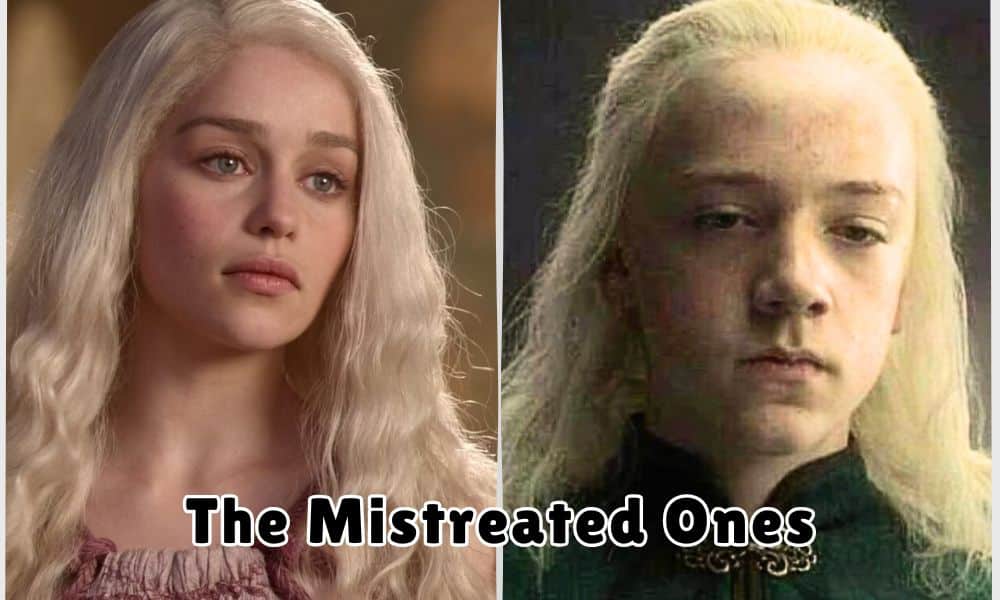
Daenerys Targaryen and Aemond Targaryen are reflections of each other across time and story. Both endure humiliation from their families, suffer deep personal losses and pay terrible prices for their connection to dragons. They are vilified for their acts of violence, condemned by figures they cared for (Daenerys by Jon and Aemond by his mother and Helaena) and ultimately killed by those bound to them by blood. Each begins as fragile and disregarded, only to rise as one of the most powerful dragonriders of their era. Yet their power, like all Targaryen power, carries the seeds of destruction. In George R.R. Martin’s Game of Thrones and House of the Dragon, their stories serve as reminders that the fire that gives life to dragons also consumes those who wield it.
“The dragon is not a slave.”
— Daenerys Targaryen, Game of Thrones
If you wholly disagree with this take, feel as though we’ve left out an essential comparison between the two or simply want a space to vent about how much you love or hate these characters, drop a comment below.






Leave a Reply